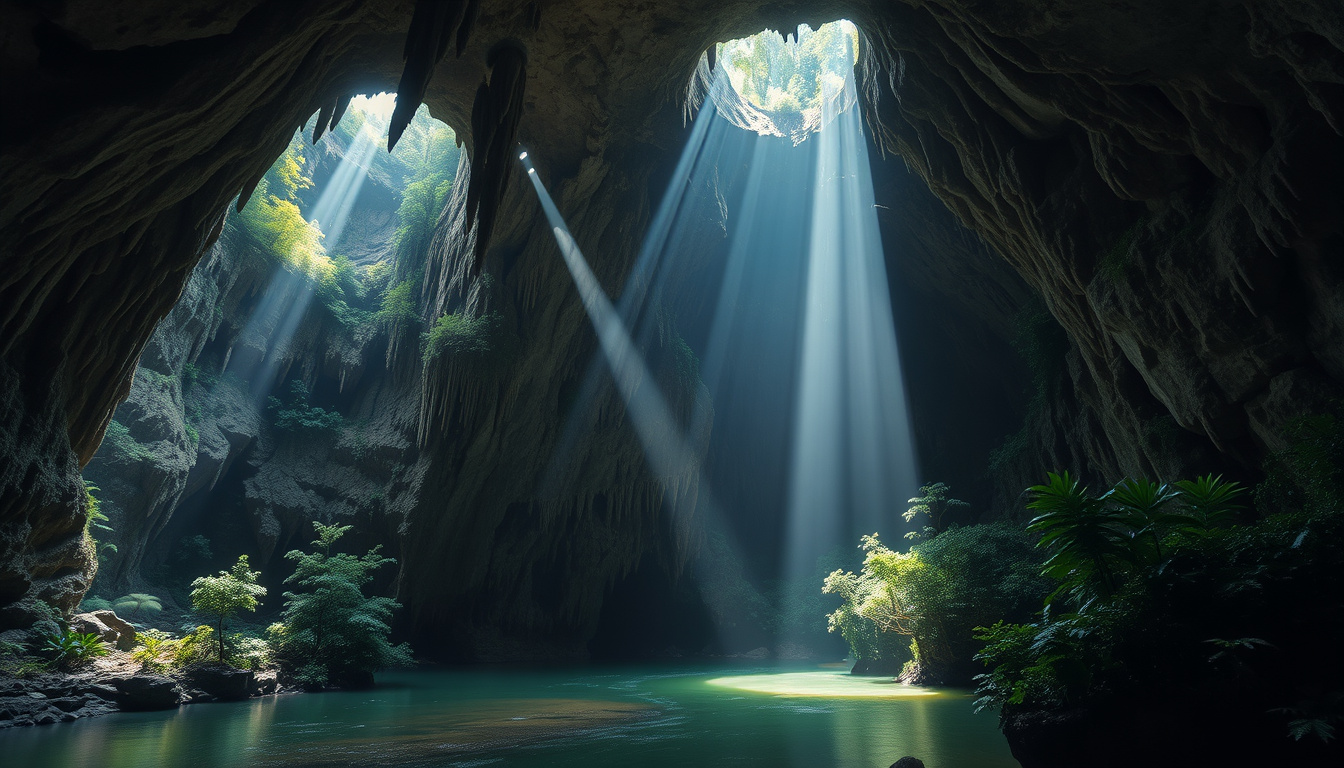

There’s a reason the phrase “world’s largest cave” draws a traveler willing to go deep, literally, into the jungle. Hang Son Doong swallows a 40-story building in its cross-section and runs 9 kilometers through Vietnam’s Phong Nha-Ke Bang National Park. This guide walks through the cost, safety, ecosystem, and booking logistics so you know exactly what a $3,000 expedition buys — and what it demands.
Largest cross-section: 200 m wide × 150 m high ·
Length: 9 km ·
Discovery year: 1990 ·
First exploration: 2009 ·
Has internal river: Yes
Quick snapshot
- Largest cross-section of any cave: 200 m × 150 m (Wikipedia (general encyclopedia))
- Contains a subterranean river & microclimate (National Geographic (established editorial publication))
- Formed in Carboniferous limestone (Britannica (reference publisher))
- Exact volume debated — some sources cite 38.5 million m³ (sondoongcave.info (cave information aggregator))
- Whether larger undiscovered caves exist in remote Karst regions (RooWanders (travel guide))
- Long-term tourism impact on cave ecosystem (The Grah Life (travel guide))
- 1990: Discovered by Ho Khanh (Wikipedia (general encyclopedia))
- 2009: Explored & mapped by BCRA team (British Cave Research Association (cave research body))
- 2013: Oxalis Adventure begins guided tours (Oxalis Adventure (tour operator))
- Permit cap at ~1,000 visitors/year for conservation (Fairyburger (travel blog))
- Tours run January–August, closed in rainy season (Oxalis Adventure (official tour operator))
- Ongoing scientific studies of microclimate & biodiversity (Wikipedia (general encyclopedia))
The following table provides a quick reference of Son Doong’s dimensions and tour logistics.
| Attribute | Value |
|---|---|
| Official name | Hang Sơn Đoòng |
| Location | Phong Nha-Ke Bang National Park, Vietnam |
| Cross-section | 200 m × 150 m |
| Length | 9 km |
| Discovery year | 1990 |
| First exploration | 2009 |
| Tour operator | Oxalis Adventure |
| Tour duration | 4 days / 3 nights |
| Tour cost | $3,000 – $3,500 |
| Annual visitors | Approximately 1,000 |
Why is Hang Son Doong so expensive?
At $3,000 per person, the Son Doong Expedition is one of the most expensive cave tours in the world. The price reflects a bundle of factors that most travelers never see.
What does the Son Doong tour price include?
- Permit from the Phong Nha-Ke Bang National Park authorities (Oxalis Adventure (official tour operator))
- Expert guides — the same British Cave Research Association explorers who mapped the cave (The Grah Life (travel guide))
- Safety equipment: helmets, headlamps, climbing gear, harnesses, and oxygen monitors
- Full camping setup inside the cave (tents, sleeping bags, meals prepared by porters)
- 12 porters per expedition to carry gear and supplies (Fairyburger (travel blog))
How does the cost compare to other Vietnam cave tours?
A typical day trip to Paradise Cave (Phong Nha) costs about $10–$20. Even the multi-day Hang En Cave expedition runs around $500–$800. Son Doong is 4x to 6x more expensive because of the permit cap — only about 1,000 visitors per year — and the extreme logistics of hauling equipment 9 km into a cave that has its own weather.
The cost buys exclusivity and safety infrastructure that no other cave tour in Vietnam can match. For the traveler, the question is whether the experience justifies a price comparable to a round-the-world flight.
The pattern: the more remote and fragile the cave, the higher the price — and Son Doong sits at the top of both curves.
What lives inside the largest cave?
Son Doong is not a barren cavern. It contains a full ecosystem, including a river, jungle, and clouds.
Does Son Doong have its own ecosystem?
- A fast-flowing subterranean river runs the entire length of the cave (Wikipedia (general encyclopedia))
- The river creates fog and clouds inside the cave, forming a microclimate distinct from the outside (National Geographic (established editorial publication))
- The cave is home to unique species: blind fish, cave centipedes, and rare algae found nowhere else (Wikipedia (general encyclopedia))
What is the cave forest like?
- Inside Son Doong, a dense jungle reaches tree heights up to 30 meters (RooWanders (travel guide))
- The cave’s “gardens” are fed by sunlight through two massive collapse dolines that allow plant growth to flourish
- Temperatures inside stay between 22–25°C year-round, but humidity is high (sondoongcave.info (cave information aggregator))
The ecosystem is why cave conservation rules are strict. A single lost hiker or a dropped plastic bottle can disrupt a microclimate that took thousands of years to balance.
The implication: visitors are not just walking through a hole in the ground — they are passing through a living, breathing environment that is more fragile than most rainforests.
Can tourists visit the biggest cave?
Yes — but with strict limits. Son Doong is not a walk-in attraction. The only way in is through a multi-day organized expedition.
Who is allowed to visit Son Doong?
- Minimum age: 18 (RooWanders (travel guide))
- Maximum age: 70 (The Grah Life (travel guide))
- Weight limit: under 100 kg (220 lbs) (The Grah Life (travel guide))
- Must be physically fit and able to hike rugged terrain with steep ascents and river crossings (Oxalis Adventure (official tour operator))
- Applicants are vetted via a fitness questionnaire and a health check before acceptance (The Grah Life (travel guide))
What is the tour itinerary like?
- The expedition lasts 4 days / 3 nights (some resellers offer 6-day/5-night packages) (Fairyburger (travel blog))
- Each group is capped at 10 participants (RooWanders (travel guide))
- Day 1: trek through jungle to Hang En (world’s third-largest cave) and camp at its entrance
- Day 2: enter Son Doong, explore the first doline (Garden of Edam), camp inside
- Day 3: continue to the second doline (Garden of Doong), cross the river, camp near the fossil passage
- Day 4: exit through the upstream entrance and trek back to base (Oxalis Adventure (official tour operator))
The catch: the tour runs only from January to August. During the rainy season (September–December), the cave is closed due to flood risk (RooWanders (travel guide)).
Is Hang Son Doong the largest cave in the world?
By cross-section, yes. By volume, it’s generally accepted as the largest, though exact measurements vary.
How was Son Doong measured?
- The cross-section at its widest point is 200 meters wide and 150 meters high (Wikipedia (general encyclopedia))
- The total length is approximately 9 kilometers (Britannica (reference publisher))
- Volume estimates range from 38.5 million cubic meters up to possibly larger (sondoongcave.info (cave information aggregator))
- The measurements were confirmed by the British Cave Research Association in 2009 (British Cave Research Association (cave research body))
Has any larger cave been discovered since?
- No larger cave has been confirmed as of 2025 (Wikipedia (general encyclopedia))
- Other large caves include Hang En (Vietnam) — the third-largest by volume, and Deer Cave (Malaysia) — long but narrow (Wikipedia (general encyclopedia))
- However, the worldwide karst landscape is only partially surveyed; undiscovered giants may exist in remote jungles
What this means: Son Doong holds the record for now, but the title is based on the best-known measurements of cross-section, not absolute volume. The debate keeps cave explorers motivated.
What is the fatality rate of caving?
Caving in general has a low fatality rate — far lower than mountaineering or scuba diving. For Son Doong specifically, no fatalities have occurred on any official tour as of 2025 (Oxalis Adventure (safety page)).
How safe is the Son Doong tour?
- Oxalis Adventure carries comprehensive safety gear: helmets, headlamps with backup power, climbing ropes, harnesses, and oxygen monitoring devices (Fairyburger (travel blog))
- All participants must sign a waiver, undergo a health check, and agree to follow strict protocols (The Grah Life (travel guide))
- The cave has natural ventilation, so oxygen depletion is not a concern (Wikipedia (general encyclopedia))
- Porters and guides are trained in first aid and emergency evacuation procedures (Oxalis Adventure (safety page))
What safety measures are in place inside the cave?
- The National Park requires guides to carry satellite communication devices in case of emergency
- Rope systems are used for steep sections and river crossings (Fairyburger (travel blog))
- Weather monitoring is continuous: the tour is postponed if heavy rain is forecast (RooWanders (travel guide))
The trade-off: the rigorous vetting and high guide-to-guest ratio (about 2:1) makes Son Doong one of the safest extreme cave experiences, but it also limits access and drives up cost.
Upsides
- Unmatched size and beauty — nowhere else on Earth like it
- Expert guides from the original exploration team
- All-inclusive logistics: meals, camping, safety gear, porters
- Low visitor cap means uncrowded experience
Downsides
- Very expensive — $3,000+ is prohibitive for most travelers
- Must be in excellent physical condition to complete the trek
- Only 1,000 permits per year — books out months in advance
- Closed half the year due to flood risk; no short option available
How to Book and Prepare for the Son Doong Expedition
Booking a Son Doong tour requires planning at least 6–9 months ahead. Here are the steps drawn from the official operator and traveler reports.
- Check eligibility. You must be between 18 and 70, weigh under 100 kg, and be physically fit. Complete the online fitness questionnaire on the Oxalis Adventure website.
- Choose a date. Tours run January–August. Avoid the rainy season (September–December). Peak months are February–April for mild weather.
- Book and pay a deposit. After approval, you’ll need to pay 100% of the tour cost to secure your spot, according to some reports (The Grah Life (travel guide)).
- Arrange travel to Phong Nha. Fly to Da Nang or Hanoi, then take a bus or private car (approx. 5–6 hours) to Phong Nha town. Oxalis provides shuttle from its office if you arrive early.
- Prepare your gear. The tour provides safety equipment, tents, and sleeping bags. You need sturdy hiking boots, quick-dry clothing, a waterproof jacket, a headlamp (backup), and a small daypack. No large suitcases — only what you can carry.
- Attend the pre-trek briefing. The evening before departure, Oxalis holds a safety and logistics meeting at its office in Phong Nha. Show up on time with your signed waiver and health certificate.
Cancellation policies are strict. If you cancel within 30 days of departure, you may lose the full amount. Some travelers recommend purchasing travel insurance that covers adventure trips and trip cancellation.
While the logistics are demanding, the preparation ensures a safe and unforgettable adventure.
I felt the wind and heard the sound of a river.
— Ho Khanh, discoverer of Son Doong (Wikipedia (general encyclopedia))
We were amazed by the sheer size – you could fit a 40-story building inside.
— Howard Limbert, British Cave Research Association (British Cave Research Association (cave research body))
The cost reflects the exclusive permit, expert guides, and full logistical support needed for a remote expedition.
— Oxalis Adventure spokesperson (Oxalis Adventure (official tour operator))
Editor’s note: For a traveler willing to invest time, fitness, and around $3,000, Son Doong delivers an encounter with a natural wonder that remains largely pristine. The choice is clear: plan meticulously, respect the cave’s fragility, and accept that the experience is as much about the journey and preparation as the destination itself.
Frequently asked questions
How long is the Son Doong tour?
The standard expedition is 4 days / 3 nights. Some resellers offer a 6-day / 5-night version that includes additional cave exploration outside Son Doong.
What is the best time to visit Son Doong?
The tour operates from January to August. February through April offer the most stable weather — lower rainfall and comfortable temperatures inside the cave (22–25°C). The rainy season (September–December) is too dangerous due to flooding.
Is Son Doong suitable for first-time cavers?
Not really. The trek involves steep climbs, river crossings, and up to 10 hours of hiking per day. First-time cavers should start with a shorter trip like Hang En or Paradise Cave to assess their fitness and comfort underground.
Are there age or fitness restrictions?
Yes. Participants must be between 18 and 70 years old, weigh under 100 kg, and pass a health and fitness screening. You’ll need to hike uneven terrain with a daypack for several hours daily.
What safety equipment is provided on tour?
Oxalis provides helmets, headlamps with backup batteries, climbing ropes and harnesses for steep sections, first-aid kits, satellite communication devices, and oxygen monitors. Guides carry emergency evacuation plans.
How do I book a Son Doong tour?
Book directly through Oxalis Adventure (official tour operator) — the only authorized operator. Fill out the online form, complete a fitness questionnaire, and pay a deposit or full amount to confirm your spot. Expect to book at least 6 months in advance.
What happens if I need to cancel my tour?
Cancellation policies are strict. Typically, cancelling within 30 days of departure results in loss of the full fee. Many travelers purchase adventure travel insurance that includes trip cancellation coverage. Contact Oxalis directly for their exact terms.
These frequently asked questions cover common concerns, but for specific inquiries, contacting Oxalis directly is recommended.
Related reading: Fiordland National Park: Te Anau, Milford Sound & Tips · Bruny Island Cruises 2026: Guide, Prices & Best Tours

Rachel Bennett leads fact-checking, source verification and corrections at Coast Monitor.