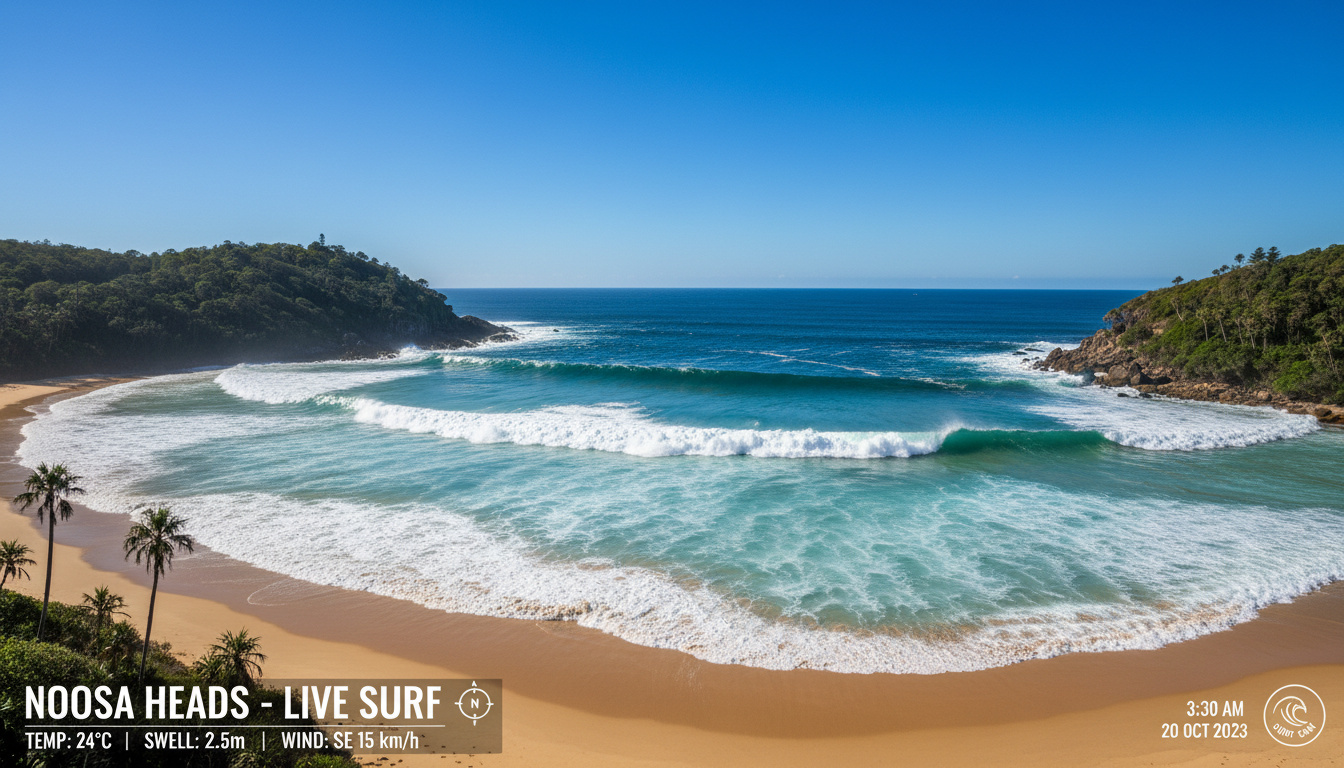
Noosa Heads sits on Queensland’s Sunshine Coast as one of Australia’s most photographed surf destinations, where golden beaches meet a north-facing coastline that demands precise swell alignment to awaken. Live surf cameras positioned across Main Beach and the headland offer real-time windows into conditions that can shift from flat to firing within hours during cyclone season.
The utility of these feeds extends beyond simple wave checks. With water temperatures hovering around 20°C and crowds peaking during holiday periods, verifying conditions remotely saves time and ensures safety in a region where rips near the groyne require constant vigilance.
Multiple providers now stream high-definition footage from this iconic stretch, though coverage remains uneven across the area’s distinct breaks. Understanding which camera faces which direction—and which spots lack visual coverage entirely—defines the difference between a productive session and a wasted drive.
Where to Find the Noosa Surf Cam Live Feed?
Surfline and Swellnet operate primary HD feeds covering Main Beach and Noosa Heads with mobile-optimized players.
Real-time data displays wave height, swell direction, wind speed, and tide levels updated hourly during daylight.
Visual coverage concentrates on Main Beach and the Heads, with gaps at First Point and Little Cove requiring workarounds.
Integrated prediction models show incoming east swell patterns essential for activating this north-facing coastline.
- Surfline and Swellnet maintain the primary free feeds for Noosa Heads and Main Beach
- Nomad World operates a 24-hour wide-angle webcam covering the broader Heads area
- No dedicated cameras exist for First Point or Little Cove; surfers must infer conditions from proximity cams
- Mobile access is optimized through Surfline’s app and Swellnet’s mobile-responsive web players
- Current readings show 0-1ft conditions with 0.9ft swells at 9-second intervals from the east-northeast
- East and northeast swells generate the best waves on this north-facing coast, particularly during cyclone season
| Surf Spot | Cam Availability | Wave Type | Skill Level | Hazards |
|---|---|---|---|---|
| Main Beach | Surfline, Swellnet | Beach break | Beginner | Crowds, lessons |
| Noosa Heads | Surfline | Pointbreak | All levels | Current, rips |
| First Point | None dedicated | Right point | Experienced | Inconsistency |
| Little Cove | None dedicated | Reef/Beach | Intermediate | Rips, access |
| The Groin | Surfline | Beach break | Intermediate | Rocks |
| Tea Tree Bay | None dedicated | Pointbreak | All levels | National park |
Current Surf Conditions via Noosa Surf Cams
What the Cams Show Right Now
Visual feeds currently display small, clean conditions across the Noosa Heads region. Wave heights register 0-1ft at Main Beach and Noosa Heads proper, with a gentle 0.9ft swell at 9-second intervals from 62 degrees east-northeast. Wind readings indicate 2 knots from the southeast with occasional 7-knot gusts creating offshore texture.
Water temperature holds steady at 20°C (68°F), suggesting minimal wetsuit requirements beyond a 2mm spring suit or thermal top during early morning sessions. Tide levels sit at 1.5ft, exposing sandbars that influence break formation along the beach breaks but leave the pointbreaks underpowered until the next incoming push.
Reading the Forecast Data
Surfline’s LOTUS model predicts an incoming east swell developing through midweek, potentially generating head-high+ waves by Wednesday with favorable offshore winds. The algorithm processes hourly data points, though users seeking granular wind shifts may require premium subscriptions offering 10-minute interval updates.
East and northeast swells remain the critical variable for this coastline. South-facing swell energy dissipates against the headland’s northern orientation, meaning camera checks become essential when satellite models predict easterly quadrant systems.
Check cams mid-morning when offshore winds typically calm. Afternoon onshore breezes create texture that cameras exaggerate; combine visual checks with Bureau of Meteorology wind data for accuracy.
Best Noosa Surf Cams by Beach and Spot
Main Beach and The Groin
Main Beach offers the most reliable camera coverage and consistent beginner-friendly waves. Multiple providers maintain overlapping feeds here, creating redundancy if one stream fails. The beach break produces left and right-handers suitable for softboards and lessons, though the density of surf schools requires careful crowd assessment before paddling out.
The Groin, located at the southern end of Main Beach near the rock wall, generates a right-hand beach break best viewed through Surfline’s dedicated angle. This spot handles all tides but demands awareness of submerged rocks near the groyne structure.
First Point and National Park Areas
First Point represents Noosa’s most famous wave—a mythical right-hand pointbreak forming part of a five-point chain running through the national park. No dedicated camera covers this specific break, forcing experienced surfers to interpret distant views from the Noosa Heads cams or rely on direct beach reconnaissance.
The wave faces north, requiring specific cyclone or east swells to activate. When conditions align, it produces long, hollow rides, but the lack of visual verification means many arrive to find flat water despite promising forecasts.
First Point lacks dedicated camera coverage despite being Noosa’s most famous wave. Surfers must rely on distant views from Noosa Heads cams or local reports, creating uncertainty during critical swell events.
Mobile Access and Alternative Viewing Strategies
Streaming protocols have evolved to accommodate smartphone users, with Swellnet and Surfline offering native applications that cache images to reduce data consumption. Nomad World’s 24-hour feed operates through browser-based players accessible on mobile networks, though high-definition streams consume approximately 3MB per minute of viewing.
When Main Beach shows minimal energy, savvy surfers check indirect indicators. Nearby north shore spots like Tea Tree Bay and Granite Bay frequently register 1-2ft+ or even 3-4ft when the main breaks stay flat, though these locations lack visual coverage entirely. Regional surf clubs sometimes maintain additional feeds covering Coolum and other nearby breaks that share similar swell windows.
For those furnishing coastal properties nearby, selecting appropriate gear like an Outdoor Coffee Table – Best Materials Sizes and Picks complements the lifestyle, but wave selection ultimately depends on interpreting these digital feeds accurately.
Download Surfline’s mobile app for cached forecasts and lower-bandwidth image grabs when monitoring conditions remotely, reducing data usage by up to 60% compared to browser streaming.
Noosa Surf Season: When to Check the Cams
- January–March: Cyclone season delivers rare easterly groundswells. First Point activates during these high-angle events. Source: Nomad World
- April–May: Transitional period with inconsistent southeast trade swells. Main Beach remains the reliable option. Source: Beachsafe
- June–August: Winter brings smaller, cleaner waves. Water temperature drops to 20°C; cams show glassy morning sessions before 9am wind shifts. Source: Surfline
- September–November: Spring buildup begins. North shore spots like Granite Bay show 3-4ft while Main Beach stays small. Source: Surfsphere
- December: Holiday crowds peak. Cams essential for avoiding lesson zones and tourist swimmers at Main Beach. Source: Noosa Surf Club
- Year-round: Consult Swellnet-powered feeds for continuous monitoring regardless of season.
What We Know vs. What Remains Uncertain About Noosa Surf Cams
| Established Facts | Uncertain or Unverified Information |
|---|---|
| Surfline and Swellnet provide primary HD feeds for Main Beach and Noosa Heads | Exact camera resolution specifications and sensor types remain unpublished |
| Nomad World operates a verified 24-hour wide-angle cam | Maintenance schedules and downtime frequencies are not publicly disclosed |
| Water temperature averages 20°C (68°F) based on recent readings | Historical cam archive accessibility and retention periods |
| No dedicated cameras exist for First Point, Little Cove, or Tea Tree Bay | Whether future infrastructure will cover these gaps |
| Current swell models predict head-high+ waves within 72 hours | Real-time accuracy of crowd density indicators on digital feeds |
| Rips near the groyne create documented hazards visible on Main Beach cams | Specific algorithms used by providers to enhance low-light imagery |
Why Noosa’s Geography Demands Strategic Cam Use
Noosa’s north-facing orientation creates a unique meteorological filter. Unlike east-facing beaches that receive unobstructed Pacific energy, Noosa Heads requires swells from specific easterly or northeasterly angles to penetrate the bay. This geographic reality makes live visual confirmation essential; forecast models may predict swell that fails to wrap into the points with sufficient size.
The tourism economy further complicates surf accessibility. Hastings Street runs parallel to Main Beach, bringing thousands of visitors who crowd the lineup during lessons. Cameras allow locals to assess human traffic density alongside wave quality, informing decisions to seek alternatives at The Groin or Granite Bay when the main break resembles a swimming pool.
For comprehensive coastal living guides including the Weeping Lilly Pilly – Care Pruning and Growing Guide, local resources provide essential knowledge alongside surf intelligence.
Authority Sources and Official Statements
Beach conditions at Noosa Heads feature low waves averaging 0.5-1m on a continuous bar with rips present near the groyne. North-facing exposure significantly limits available swell compared to open coast beaches.
First Point represents a mythical right-hand pointbreak that remains inconsistent due to its north-facing orientation. The wave relies on cyclone or east swells to break properly, making it one of Australia’s most fickle world-class waves.
— Surfline
The Noosa Surf Club maintains patrols along Hastings Street beachfront, providing safety information and current condition assessments for swimming and surfing zones.
Key Takeaways for Monitoring Noosa Surf
Effective use of Noosa’s surf camera network requires understanding both technological capabilities and coastal geography. Surfline and Swellnet deliver reliable visual feeds for Main Beach and Noosa Heads, while significant coverage gaps remain at First Point and Little Cove. Swell direction determines wave quality more than height on this north-facing coast, making real-time camera verification essential during forecasted easterly events.
Frequently Asked Questions
Is there a free Noosa surf cam specifically for First Point?
No dedicated camera covers First Point. Surfers must use the Noosa Heads cam for distant views or rely on direct observation.
How accurate are Noosa surf cam conditions compared to reality?
Cameras generally lag 1-5 minutes behind real-time. Water refraction and lens angles can make waves appear smaller than actual size, particularly at low tide.
Why do Noosa surf cams show flat conditions so often?
The north-facing coast blocks swells from southerly directions. Eastern swells needed for quality surf occur intermittently, primarily during cyclone season.
Can I check Noosa surf cams at night?
Yes, the Nomad World cam operates 24 hours. However, low-light conditions limit visibility; infrared or night-vision capability varies by provider.
What is the current water temperature at Noosa Heads?
Recent readings indicate 20°C (68°F). A 2mm wetsuit or SPF 50 sun protection is recommended depending on session length and time of day.
Which Noosa beach has the most reliable cam coverage?
Main Beach offers the most redundant coverage with feeds from both Surfline and Swellnet, providing multiple angles of the beach break and groyne area.
Are Noosa surf cams accessible on mobile devices?
Yes. Surfline provides dedicated mobile apps, while Swellnet and Nomad World offer mobile-responsive web players optimized for smartphone viewing.

Rachel Bennett leads fact-checking, source verification and corrections at Coast Monitor.