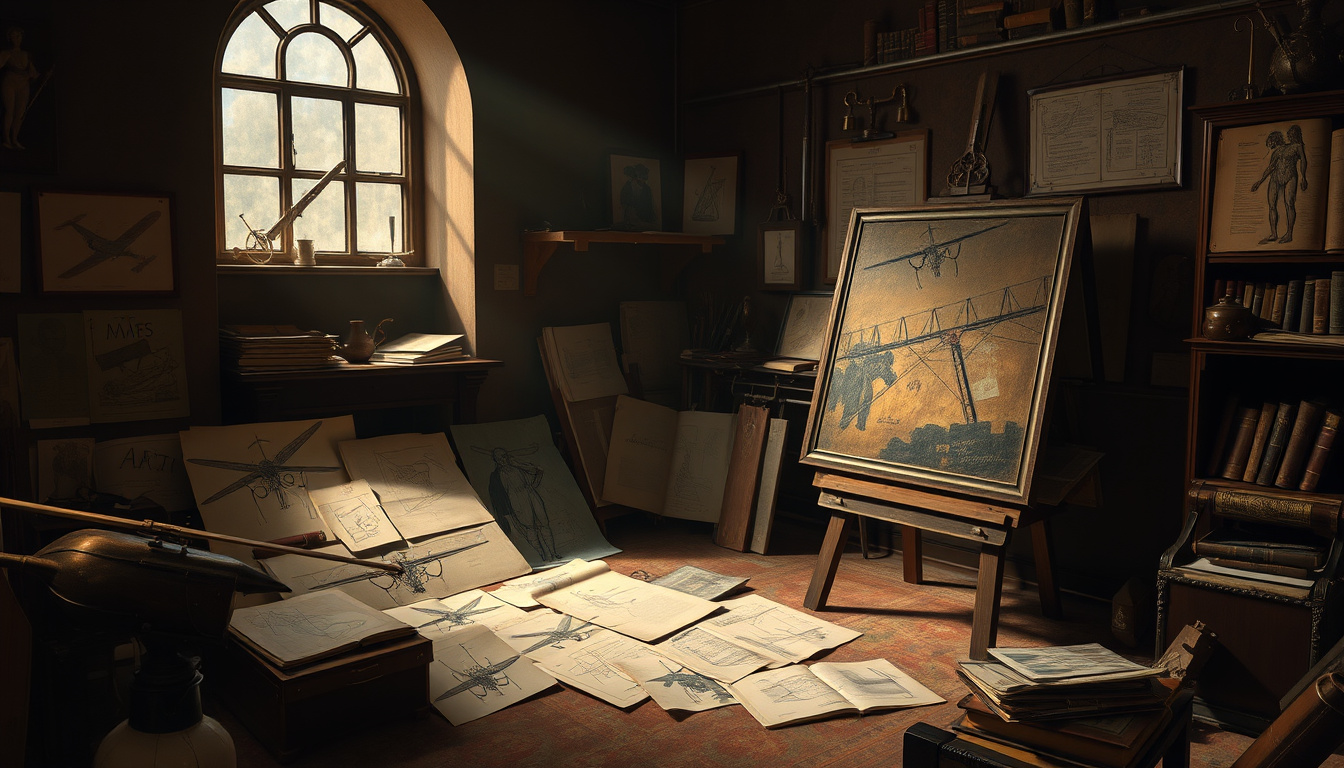

Most people know Leonardo da Vinci as the man behind the Mona Lisa’s enigmatic smile. But the real Leonardo — the one who filled thousands of notebook pages with flying machines, anatomical studies, and engineering sketches — was far more complicated than any portrait.
Full name: Leonardo di ser Piero da Vinci ·
Born: April 15, 1452, Vinci, Italy ·
Died: May 2, 1519, Amboise, France ·
Known for: Painting, engineering, anatomy, sculpture ·
Famous works: Mona Lisa, The Last Supper, Vitruvian Man ·
Number of surviving paintings: Fewer than 20
Quick snapshot
- Born in Vinci, Italy, in 1452 (Encyclopaedia Britannica)
- Painted the Mona Lisa starting around 1503 (Museum of Science)
- Died at Clos Lucé, France, in 1519 (The Metropolitan Museum of Art)
- Exact nature of his relationship with student Salai
- Whether his last words were as Vasari reported
- Details of his sleep schedule — no contemporary evidence
- 1472: Accepted into Florence painters’ guild (Britannica timeline)
- 1480s: Entered service of Ludovico Sforza in Milan (Met Museum)
- 1516: Left Italy for France under Francis I (Britannica)
- Ongoing research into his anatomical drawings
- Continued restoration of The Last Supper
- Historical scholarship challenging myths about his personal life
A glance at the key documented facts reveals a life that spanned the full arc of the High Renaissance: from a small Tuscan village to the court of the French king.
| Attribute | Value |
|---|---|
| Birth | April 15, 1452 |
| Death | May 2, 1519 |
| Nationality | Italian |
| Known for | Painting, sculpture, architecture, science, engineering |
| Famous works | Mona Lisa, The Last Supper, Vitruvian Man |
| Number of surviving paintings | Fewer than 20 |
Why is Leonardo da Vinci so famous?
What made him a Renaissance man?
- He mastered multiple disciplines — painting, sculpture, engineering, anatomy, and botany — earning the label “Renaissance man” centuries later (Encyclopaedia Britannica, reference publisher).
- His notebooks, estimated at nearly 2,500 sheets, show his relentless curiosity (The Metropolitan Museum of Art, premier art institution).
- He trained under Andrea del Verrocchio in Florence and was admitted to the painters’ guild by 1472 (Britannica timeline).
Legacy in art and science
- The Mona Lisa and The Last Supper are among the most reproduced artworks globally (Musée du Louvre, home of the Mona Lisa).
- His scientific studies — from human anatomy to optics and geology — were centuries ahead of their time (Britannica summary).
- Yet his output as a finished painter was small: fewer than 20 surviving paintings (Met Museum).
The implication: his reputation has grown precisely because he left so many open questions — giving each generation something new to discover.
What are the top 3 most famous paintings?
The Mona Lisa
- Painted between 1503 and 1519, now at the Louvre in Paris (Musée du Louvre).
- Famous for the subject’s expression, sfumato technique, and theft in 1911 that boosted its fame.
- It remains the most visited single artwork in the world (Encyclopaedia Britannica).
The Last Supper
- A mural painted 1495–1498 for the refectory of Santa Maria delle Grazie in Milan (Encyclopaedia Britannica).
- Depicts the moment Jesus announces one disciple will betray him.
- Badly deteriorated due to Leonardo’s experimental technique, but restoration efforts continue (The Metropolitan Museum of Art).
The Vitruvian Man (drawing)
- Created around 1490, it illustrates ideal human proportions based on the Roman architect Vitruvius.
- Held by the Gallerie dell’Accademia in Venice (Encyclopaedia Britannica).
- Became an icon of Renaissance humanism, reproduced on everything from coins to textbooks (The Metropolitan Museum of Art).
The Mona Lisa’s fame isn’t just artistic — it’s a case study in how theft, media, and mystery can elevate a painting into a global phenomenon. For museum visitors, the real payoff is seeing how Leonardo’s sfumato creates that famously elusive smile.
The pattern: Leonardo’s most famous works share a common thread — they each embody a fusion of art and intellectual inquiry, making them as much scientific as aesthetic achievements.
What did Leonardo da Vinci invent that we use today?
Flying machines
- He designed an ornithopter (a wing-flapping aircraft) and a helical air screw, a precursor to the helicopter (Museum of Science, Boston).
- None were built in his lifetime — materials and power sources didn’t exist.
War machines
- Sketches include a giant crossbow, armored vehicle (proto-tank), and multi-barrel gun (Encyclopaedia Britannica).
- Many were likely conceptual exercises rather than practical designs.
Hydraulic pumps
- He studied water flow and designed pumps, canal systems, and devices for raising water (The Metropolitan Museum of Art).
- Influenced later hydraulic engineering in Italy and France.
Self-supporting bridge
- A portable bridge design that uses interlocking beams requiring no fasteners (Britannica timeline).
- Recreated by engineers and used as a model for modern temporary bridges.
Parachute and diving equipment
- His parachute sketch (c. 1485) shows a pyramidal canopy. In 2000, a British skydiver tested a replica and landed safely (Museum of Science, Boston).
- Diving gear included a leather air tank and snorkel.
The trade-off: brilliant ideas without execution. Leonardo himself may have seen invention as intellectual play rather than a path to production.
Who was da Vinci’s lover?
Salai (Il Salaino)
- Salai (real name Gian Giacomo Caprotti) joined Leonardo’s household as a boy around 1490 and stayed for over 20 years (Encyclopaedia Britannica).
- Leonardo described him as a “thief, liar, stubborn, glutton” in notebooks, yet left him valuable artworks.
Francesco Melzi
- Melzi became Leonardo’s pupil, assistant, and eventual heir after 1506 (The Metropolitan Museum of Art).
- He inherited Leonardo’s manuscripts and cared for them until his own death.
Possible relationships with Caterina?
- Some historians speculate that a woman named Caterina who lived with Leonardo in Milan may have been a servant or relative, not a lover.
The question of his sexuality
- There is no definitive document confirming a romantic relationship with any individual.
- Speculation about Leonardo being gay or bisexual arises from his close male companions and a 1476 accusation of sodomy (later dismissed) when he was in Florence (Smithsonian Magazine, history publication).
- Modern scholars caution against projecting labels onto historical figures without direct evidence.
For LGBTQ history enthusiasts, Leonardo is often claimed as a gay icon. Yet the historical record is maddeningly silent — no love letters, no diary confession. The truth is that we simply don’t know, and the absence of evidence is not evidence of absence.
What this means: the question of Leonardo’s love life remains one of the most tantalizing gaps in his biography — a blank that each generation fills with its own assumptions.
What were Leonardo da Vinci’s last words before he died?
Reported last words attributed by Vasari
- Giorgio Vasari, writing decades after Leonardo’s death, claimed his final words were: “I have offended God and mankind because my work did not reach the quality it should have.” (Encyclopaedia Britannica on Vasari)
Skepticism about the authenticity
- No contemporary witness recorded the scene. Vasari was not present — he began collecting material for his Lives of the Artists in the 1540s.
- Many historians suspect the deathbed words are a literary device to dramatize Leonardo’s supposed regret.
The catch: Vasari’s account, though unreliable, has shaped the popular image of a tormented genius — a narrative that persists despite a lack of evidence.
How many hours did da Vinci use to sleep?
The Uberman sleep cycle myth
- An online rumor claims Leonardo practiced “polyphasic sleep” — 20-minute naps every 4 hours, totaling about 2 hours per day.
- No mention of this appears in his notebooks or any contemporary record (BBC Future, science and culture outlet).
Historical evidence of his sleep habits
- Fifteenth-century sleep patterns were segmented — people often slept in two blocks (first and second sleep).
- Leonardo likely followed the same rhythm as his peers: 7–9 hours total, possibly with a midafternoon rest.
Comparison with Nikola Tesla
- Tesla is famous for claiming he only slept 2 hours per day — also largely mythologized.
- Both men are used as examples of extreme productivity, but the sleeping legends don’t hold up to scrutiny.
The pattern: the polyphasic sleep myth is a classic example of a modern internet story being retroactively attached to a historical figure. For anyone curious about productivity hacks, the lesson is that Leonardo’s genius wasn’t about sleep deprivation — it was about focused curiosity.
Confirmed facts vs. what remains unclear
Confirmed facts
- Born in Vinci, Italy, in 1452 (Encyclopaedia Britannica)
- Apprenticed to Verrocchio in Florence (Met Museum)
- Painted the Mona Lisa starting around 1503 (Museum of Science)
- Drafted The Last Supper for Santa Maria delle Grazie (Britannica)
- Designed many inventions but few were built during his lifetime
- Died in France on May 2, 1519 (Met Museum)
What’s unclear
- Exact relationship with Salai — romantic or purely professional?
- Whether he had any long-term romantic partner
- Authenticity of his reported last words
- The polyphasic sleep story — no contemporary source
- Exact count of his completed paintings; fewer than 20 are confidently attributed
- Precise number of surviving manuscript pages (estimates vary)
The evidence around Leonardo’s final years paints a picture of a man who never stopped working — even his last recorded words, whether genuine or invented, reflect a relentless dissatisfaction with his own output.
For readers interested in how historical myths are born, the stories around Leonardo’s sleep, love life, and last words offer a perfect case study. The lesson is clear: without contemporary documentation, even the most colorful anecdotes should be taken with a grain of salt. In fact, the same principle applies to modern claims about MSG safety and myths, where persistent online rumors often outrun the science. And just as we question ancient legends, we can look at how the Pyramids of Giza have been wrapped in their own layers of myth — a reminder that every era spins stories about the past.
“Simplicity is the ultimate sophistication.”
— Leonardo da Vinci, from his notebooks (LeonardoDaVinci.net, comprehensive biography site)
“Patience serves as protection against wrongs as clothes do against cold.”
— Leonardo da Vinci, notebook entry (LeonardoDaVinci.net)
“I have offended God and mankind because my work did not reach the quality it should have.”
— Giorgio Vasari, biographer of Leonardo (attributing these as Leonardo’s last words) (Encyclopaedia Britannica on Vasari)
creativelearningconnection.com, en.wikipedia.org, youtube.com
Frequently Asked Questions
Where was Leonardo da Vinci born?
He was born on April 15, 1452, in the small town of Vinci in the Republic of Florence (Encyclopaedia Britannica).
How did Leonardo da Vinci die?
He died on May 2, 1519, at Clos Lucé in France, likely from a stroke or natural causes (The Metropolitan Museum of Art).
What is the Vitruvian Man?
It is a drawing from about 1490 that illustrates ideal human proportions based on the Roman architect Vitruvius. It is both an artistic and scientific study (Britannica).
Did Leonardo da Vinci have children?
No surviving records indicate that Leonardo fathered any children. He was born out of wedlock but had no known offspring (Met Museum).
What was Leonardo da Vinci’s education?
He received little formal schooling; he was taught at home and later apprenticed to Andrea del Verrocchio in Florence, where he learned painting, sculpture, and technical skills (Museum of Science).
How many of Leonardo da Vinci’s paintings survive?
Fewer than 20 paintings are confidently attributed to him, a small number compared to his fame (Met Museum).
What is the secret of the Mona Lisa smile?
The elusive quality of her smile is achieved through sfumato — a technique that blurs edges and blends colors, creating an ambiguous expression that changes with the viewer’s angle (Musée du Louvre).

Rachel Bennett leads fact-checking, source verification and corrections at Coast Monitor.