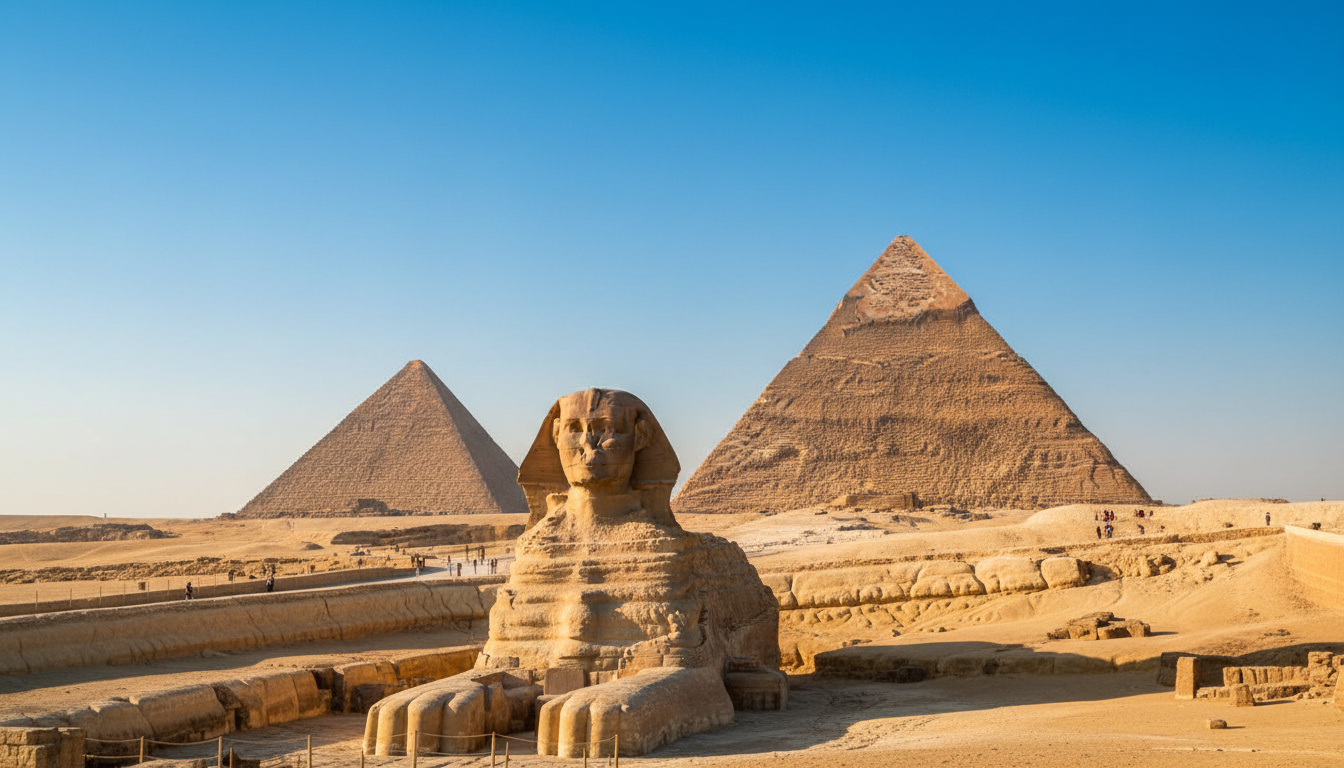
The Pyramids of Giza form a 4th Dynasty necropolis (c. 2575–2465 BCE) on the rocky plateau of Giza, west of the Nile River and southwest of modern Cairo. Built for pharaohs Khufu, Khafre, and Menkaure, these monuments served as royal tombs designed to facilitate the pharaoh’s ascent to the afterlife. The complex extends beyond the three primary pyramids to include the Great Sphinx, valley temples, causeways reaching one kilometer in length, and thirty-five boat pits carved into the bedrock.
Archaeological evidence confirms the Great Pyramid’s base alone covers approximately thirteen acres. The structures functioned as part of elaborate mortuary complexes featuring temples for ritual offerings. Suburban Rail Loop construction timeline research shares methodological parallels with the logistical coordination required for ancient Egyptian projects of this magnitude.
Today, the plateau stands as the only surviving site among the Seven Wonders of the Ancient World, attracting continuous study through modern technologies including muon tomography. UNESCO recognizes the entire necropolis as a World Heritage site, preserving the architectural record alongside the archaeological evidence of the skilled workers who built these enduring symbols.
Who Built the Pyramids of Giza?
| Location | Giza Plateau, Egypt |
| Built | c. 2580–2560 BC (Khufu) |
| Height | 146m (Great Pyramid original) |
| Status | UNESCO World Heritage |
- Skilled workforce: Tens of thousands of paid workers, not slaves, organized in hierarchical systems according to Britannica and archaeological consensus.
- Team structure: Workers divided into gangs of 200, then subdivided into teams of 20 for specific tasks.
- Compensation: Laborers received salaries or participated as part of tax levy obligations.
- Seasonal labor: Agricultural workers joined construction during Nile flood periods when farming was impossible.
- Archaeological proof: Workers’ cemeteries discovered in 1990 contain evidence of medical care and dietary provisions, confirming their status as valued laborers.
- Architectural leadership: Hemiunu served as architect for Khufu’s pyramid, evolving designs from earlier step pyramid traditions established by Imhotep.
- Historical correction: Greek historian Herodotus’s slave narrative has been definitively debunked by Egyptology.
| Pyramid | Pharaoh | Original Height | Base | Angle |
|---|---|---|---|---|
| Great Pyramid | Khufu | 146.6 m | ~13 acres | 51°52′ |
| Pyramid of Khafre | Khafre | ~143 m | Slightly smaller | Steep |
| Pyramid of Menkaure | Menkaure | ~65 m | Smallest of three | — |
| Great Sphinx | Guards Khafre’s complex | ~20 m high | Carved from bedrock | — |
How Were the Pyramids of Giza Built?
Materials and Sourcing
The primary building material consisted of limestone quarried locally from the Giza plateau for the core structure, with fine white limestone casing stones transported from Tura across the Nile. Granite used for burial chambers, portcullis blocks, and portions of Menkaure’s casing arrived from Aswan, approximately 1,500 kilometers to the south. Workers filled gaps between rough core stones using gypsum mortar and local rubble.
Heavy granite blocks traveled roughly 1,500 kilometers from Aswan quarries via the Nile, utilizing a now-receded river branch connected to the plateau by a 6.5-kilometer canal system.
Ramp Systems and Lifting
Workers quarried stone using copper tools, then dragged blocks averaging 2.5 tons on sledges over lubricated wet silt. Teams of approximately twenty men could move a block in roughly twenty minutes. Construction analyses indicate earthen ramps constructed from brick and sand facilitated lifting, with configurations ranging from straight frontal ramps to spiral designs wrapping around the pyramid or multi-ramp systems on all four sides.
Archaeologists debate whether builders used straight, spiral, or multi-sided earthen ramp configurations. Post holes and staircases suggest central ramps with 20% slopes may have assisted with upper courses, though the exact combination remains under investigation.
Transport logistics relied on ropes, wooden levers, and rollers, without the use of pulleys, wheels, or iron tools. Despite these rudimentary implements, the builders achieved modern-level precision, leveling the plateau to within a fraction of an inch.
Construction proceeded without iron tools, pulleys, or wheeled vehicles. All movement relied on human and animal power combined with wooden sledges and simple levers.
How Old Are the Pyramids of Giza?
Pharaohs and Dynastic Timeline
The Giza complex dates to Egypt’s 4th Dynasty, approximately 4,500 to 4,600 years old. Pharaoh Khufu reigned from c. 2589–2566 BCE, initiating his pyramid at the start of his reign. Recent chronological studies place the Great Pyramid’s completion around 2560 BCE. Khafre ruled c. 2558–2532 BCE, constructing his pyramid and the Sphinx, while Menkaure reigned c. 2532–2503 BCE, building the smallest of the three main pyramids.
Construction Duration
Khufu’s Great Pyramid required approximately twenty years to complete, utilizing roughly 2.3 million stone blocks. The entire Giza complex developed over roughly one hundred years across five pharaohs, including precursors like Snefru who evolved step pyramid designs into the smooth-sided true pyramids seen at Giza.
Why Were the Pyramids of Giza Built?
Religious Purpose and Afterlife
The pyramids served as royal tombs symbolizing the pharaoh’s ascent to the afterlife, forming part of larger mortuary complexes. Smarthistory documentation confirms these structures incorporated temples for ritual offerings and purification ceremonies essential to Egyptian funerary practice.
Each pyramid formed the centerpiece of a larger complex including valley temples for purification rituals, causeways up to one kilometer long for funeral processions, and boat pits containing vessels intended for the pharaoh’s celestial journey.
Internal Chambers
The Great Pyramid contains granite burial chambers and internal passages, though earlier sloping construction courses were abandoned as methods evolved. The granite portcullis blocks and burial chambers designed by architects like Hemiunu demonstrate sophisticated understanding of structural weight distribution.
When Did Major Construction Events Occur?
- : Step pyramids under Djoser and architect Imhotep establish architectural precedents
- : Planning begins for smooth-sided true pyramids under Pharaoh Snefru
- : Construction of Khufu’s Great Pyramid over 20 years
- : Completion of Khafre’s pyramid and the Great Sphinx
- : Menkaure’s pyramid completed, finishing the complex
- : Discovery of workers’ cemeteries confirms workforce composition
- : Muon tomography scans reveal new structural voids
What Do We Know vs. What Remains Uncertain?
| Established Facts | Unanswered Questions & Debunked Claims |
|---|---|
| Built by Egyptian 4th Dynasty laborers during c. 2575–2465 BCE | Exact ramp configurations remain theoretical; multiple models proposed |
| Paid workforce of skilled artisans, not slaves | Specific daily labor quotas for individual teams undocumented |
| Purpose as royal tombs for afterlife journey | Complete contents of all internal chambers not fully cataloged |
| Construction span of approximately 100 years for full complex | Precise seasonal workforce fluctuations remain estimated |
| Materials sourced from Giza, Tura, and Aswan | Extraterrestrial involvement claims are scientifically unfounded; myths explained regarding aliens require no evidentiary support |
How Do the Pyramids Fit into World Heritage?
The Great Pyramid of Giza stands as the sole surviving structure from the Seven Wonders of the Ancient World, a status confirmed by Smithsonian documentation. UNESCO recognizes the Giza Necropolis as a World Heritage site, protecting not only the monumental architecture but the surrounding archaeological landscape including workers’ villages and quarries.
The precision engineering demonstrated—leveling the plateau to fractions of an inch and aligning massive granite blocks without modern machinery—continues to define the complex as a paramount achievement of ancient engineering. UNESCO listings emphasize this cultural significance.
What Do Leading Experts Say?
The discovery of the workers’ cemeteries in 1990 fundamentally changed our understanding of pyramid construction, revealing a paid, skilled workforce with access to medical care rather than coerced slave labor.
— Archaeological consensus per researchers including Zahi Hawass and Mark Lehner
Modern muon tomography has allowed us to examine these structures without invasive excavation, confirming known chambers while identifying potential new voids that require systematic investigation.
— Oriental Institute research on non-invasive scanning technologies
What Is the Core Significance?
The Pyramids of Giza represent a century-long 4th Dynasty project built by tens of thousands of paid, organized workers using ramps, sledges, and copper tools—not slaves or extraterrestrial technology. These tombs for pharaohs Khufu, Khafre, and Menkaure demonstrate engineering precision that remained unsurpassed for millennia, standing today as the last surviving ancient wonder and a testament to ancient Egyptian organizational capability.
Frequently Asked Questions
Are the Pyramids of Giza one of the Seven Wonders?
Yes. The Great Pyramid is the sole surviving structure from the Seven Wonders of the Ancient World.
How many pyramids are in Giza?
The complex contains three main pyramids: the Great Pyramid of Khufu, the Pyramid of Khafre, and the Pyramid of Menkaure.
What is the Sphinx relation to the pyramids?
The Great Sphinx guards Khafre’s pyramid complex, carved directly from the plateau bedrock as part of the same 4th Dynasty necropolis.
Who is buried in the Pyramids of Giza?
The pyramids served as tombs for pharaohs Khufu, Khafre, and Menkaure, though their original burial contents have not survived intact.
How tall is the Great Pyramid?
The structure originally stood 146.6 meters tall; erosion and the loss of the capstone have reduced this to approximately 138 meters today.
What is the best time to visit the Pyramids of Giza?
Early morning or late afternoon visits offer optimal conditions to avoid intense desert heat and peak tourist congestion.
Related stories


Liam O'Brien covers Australian politics and public affairs for Coast Monitor.