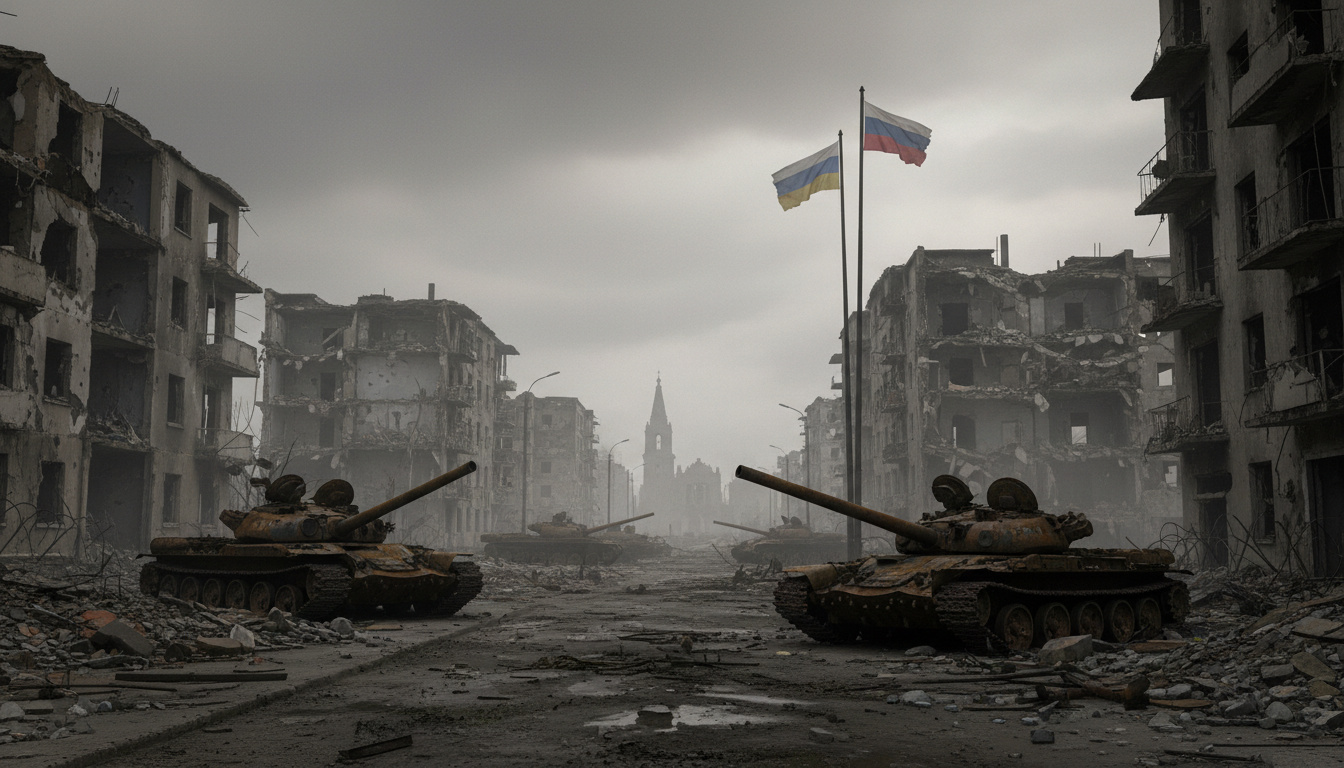
The Russo-Ukrainian War entered its fourth year in 2025 with no resolution in sight, marked by record drone attacks, staggering casualty figures, and marginal territorial shifts. What began as Russia’s full-scale invasion on February 24, 2022, has evolved into a prolonged attritional conflict characterized by contested statistics and rapidly shifting frontlines. Current assessments indicate Russia controls less than 20 percent of Ukrainian territory, down from its 2022 peak, while both nations suffer severe military losses amid intensifying aerial warfare.
The conflict’s trajectory throughout 2025 reveals strategic adaptations on both sides. Ukrainian forces conducted sophisticated drone operations against Russian infrastructure, including the high-profile Operation Spiderweb that targeted bomber fleets, while Russian forces maintained slow, grinding advances averaging merely 0.24 kilometers daily. Despite extensive international support for Ukraine and severe sanctions on Moscow, the war persists as a stalemate with profound global implications.
What is the current status of the Russia-Ukraine war?
February 24, 2022
Russia vs. Ukraine (with NATO support)
500,000+ total military (disputed)
Ongoing stalemate (as of late 2025)
The current operational environment reflects a tactical equilibrium. Russia retains control over significant portions of Donetsk and Luhansk, having recaptured Bilohorivka and advanced through Vozdvyzhenka, Sribne, and Krymske during 2025. Ukraine, conversely, has reclaimed approximately 50,000 square kilometers of territory since the invasion began—an area larger than Slovakia—though the pace of liberation has slowed considerably.
Aerial warfare dominated 2025 operations. Russian forces launched over 54 large-scale combined strikes, peaking between September 6-7 with an unprecedented wave of 810 drones and 13 missiles. Ukrainian forces responded with mass drone operations of their own, including a 121-drone attack on January 24 that forced the closure of Russian airports. These exchanges highlight the conflict’s evolution toward unmanned systems and strategic infrastructure targeting.
- Russia lost approximately 38,000 personnel in the Kursk region alone by early January 2025 according to Ukrainian military assessments
- Territorial gains remain minimal: Russia captured only 0.8% of Ukrainian territory throughout 2025 despite concentrated offensives
- Operation Spiderweb in June 2025 destroyed an estimated 20% of Russia’s strategic bomber fleet in a major Ukrainian drone operation
- Record drone attacks intensified in February 2025 when Russia launched 267 drones in a single wave
- Civilian devastation continues: Mariupol alone suffered over 20,000 civilian deaths with 90% of structures damaged
- Both sides underreport losses: Official figures represent minimum confirmed casualties rather than comprehensive totals
| Metric | Russia | Ukraine | Source |
|---|---|---|---|
| Territory Control (Late 2025) | <20% of Ukraine | Reclaimed 50,000 km² | Analysis |
| Military Killed (Est. 2022-2025) | 240,000-250,000 | 43,000-46,000 (soldiers) | Wikipedia, Britannica |
| Military Wounded (Est.) | 550,000-750,000 | 370,000-390,000 | Wikipedia |
| 2025 Territorial Gain | ~0.8% of Ukraine | Static defense | ISW |
| Daily Advance (2025 Average) | 0.24 km | — | ISW |
| Peak 2025 Strike | 810 drones + 13 missiles (Sep 6-7) | 121 drones (Jan 24) | ISW, Wikipedia |
| Summer 2025 Campaign Losses | ~15,500 fatalities | ~17,000 fatalities | Campaign Analysis |
| Strategic Bombers Lost | 20% of fleet | — | Operational Report |
What caused the Russia-Ukraine war?
The conflict’s origins trace to Russia’s annexation of Crimea in 2014 and subsequent support for separatist movements in Donetsk and Luhansk. These early actions established a pattern of territorial interference that culminated in the full-scale invasion on February 24, 2022. Eight years of low-intensity warfare and diplomatic friction preceded the comprehensive military assault.
Annexation of Crimea and Early Conflict
Russian military forces occupied and subsequently annexed Ukraine’s Crimean Peninsula in March 2014, following the Ukrainian Revolution of Dignity. Concurrently, Moscow began providing material support to pro-Russian separatists in eastern Ukraine’s Donbas region, triggering a localized conflict that claimed over 14,000 lives before 2022. These actions established the geographic and political fault lines that would expand dramatically eight years later.
The 2014 annexation followed Ukraine’s pivot toward European integration, which Russian leadership characterized as a threat to strategic interests. This period saw the emergence of the self-declared Donetsk and Luhansk People’s Republics, sustained by Russian logistical and military support despite formal denials.
Full-Scale Invasion Triggers
Russia’s 2022 invasion followed months of military buildup along Ukraine’s borders. Moscow cited the need to protect Russian-speaking populations in Ukraine as primary justification, alongside assertions that NATO expansion posed an existential security threat. Ukrainian and Western sources universally characterized the assault as unprovoked aggression, rejecting territorial protection claims as pretexts for imperial expansion.
Stated Motivations versus International Assessment
While Russian officials emphasized denazification of Ukraine and protection of ethnic Russians, international observers noted the invasion’s timing coincided with Ukraine’s deepening Western orientation rather than any documented threat to Russian speakers. The disparity between stated justifications and observed military targeting—including extensive damage to Russian-speaking cities like Mariupol—highlighted the contested nature of causation narratives.
How many casualties in the Russia-Ukraine war?
Casualty verification presents profound challenges, with all belligerents underreporting losses and independent confirmation limited to accessible territories. Current estimates rely on intelligence assessments, satellite imagery, and sporadic official disclosures rather than comprehensive audits.
Military Personnel Losses
By February 2025, Ukrainian President Zelenskyy reported 46,000 Ukrainian soldiers killed and 380,000 injured since February 2022. Russian military fatalities ranged between 240,000 and 250,000 according to Western estimates, with total casualties—including wounded and missing—approaching or exceeding one million for Russian forces alone. The Center for Strategic and International Studies projects combined military casualties could reach two million by spring 2026.
Casualty figures vary by tens of thousands depending on the source. Ukrainian General Staff reported 391,270-416,570 Russian casualties in late 2025 assessment periods, while independent analysts suggest both sides systematically undercount fatalities to maintain morale. Leaked documents and OSINT estimates frequently contradict official statements.
Civilian Impact
Civilian casualties remain severely underdocumented, particularly in occupied territories. Mariupol suffered catastrophic destruction with over 20,000 confirmed civilian deaths and 90% of structures damaged. Ongoing strikes continue generating civilian casualties—14 died in a February 1, 2025 missile strike on Poltava, while 33 were killed in recent attacks across multiple oblasts. The true civilian toll likely far exceeds confirmed figures due to restricted access in combat zones.
Data Verification Challenges
The fog of war obscures accurate accounting. Russia classifies casualty data, while Ukraine releases updates only periodically. Independent verification through the Armed Conflict Location & Event Data Project confirms specific incidents but cannot capture comprehensive totals. Medical infrastructure limitations and rapid burial procedures in frontline areas further complicate documentation.
What is the future outlook for the Russia-Ukraine war?
Projecting the conflict’s trajectory requires analyzing attrition rates, logistical sustainability, and diplomatic stalemates. Current indicators suggest continued positional warfare rather than decisive breakthrough operations through 2025’s closing months.
Military Trajectories
Russia’s marginal territorial gains—averaging less than a quarter kilometer daily—suggest exhausted offensive capacity despite numerical advantages. Ukraine’s defensive posture focuses on preserving manpower while conducting strategic strikes against Russian infrastructure. The destruction of 20% of Russia’s bomber fleet in June 2025 demonstrated Ukrainian capacity for deep strikes, yet ground offensives remain constrained by equipment shortages and fortified Russian defenses.
Analysts at the Institute for the Study of War note that Russia’s 2025 advances, while symbolically significant, represent strategically negligible gains given the expenditure of personnel and materiel. The conflict appears locked in an attritional equilibrium where neither side currently possesses the capability or international support for rapid resolution.
Diplomatic Possibilities
Peace negotiations remain stalled over fundamental disagreements regarding territorial integrity and security guarantees. Ukrainian leadership maintains that restoration of 1991 borders represents a non-negotiable precondition, while Russian officials insist on recognition of annexed territories. International mediation efforts continue, but meaningful diplomatic breakthroughs remain elusive absent significant battlefield developments that might force concessions.
When did Russia invade Ukraine and what is the war timeline?
The conflict’s chronology reveals distinct phases, from the rapid 2022 invasion through prolonged attritional warfare and the tactical innovations of 2025.
-
Full-Scale Invasion BeginsRussia launches a comprehensive assault on multiple fronts including Kyiv, Kharkiv, and southern Ukraine, marking the beginning of the full-scale invasion phase. — Britannica
-
New Year Drone AttacksDrone strikes in Kyiv kill 2 and injure 6, initiating a year of intensified aerial warfare. — Wikipedia
-
2024 Casualty Reports ReleasedUkrainian Commander Syrskyi reports Russia lost 38,000 personnel in Kursk and 434,000 total casualties in 2024, including 150,000 killed. — Wikipedia
-
Ukrainian Drone WaveUkraine launches 121 drones over Russian territory, forcing airport closures and demonstrating expanded strike capabilities. — Wikipedia
-
Poltava Residential StrikeA Russian missile strike on a residential building in Poltava kills 14 civilians. — Wikipedia
-
Record Russian Drone AttackRussia launches a record 267-drone attack wave against Ukrainian targets. — Wikipedia
-
Operation SpiderwebUkrainian drone operation destroys an estimated 20% of Russia’s strategic bomber fleet in a significant blow to Russian air capacity. — Operational Analysis
-
Peak Strike IntensityRussia launches its most intense combined attack of 2025, deploying 810 drones and 13 missiles simultaneously. — ISW Assessment
Who is winning the Russia-Ukraine war?
Determining advantage proves complicated by contradictory metrics—territorial control versus attrition rates, equipment losses versus manpower reserves, tactical victories versus strategic positioning.
| Established Information | Information That Remains Unclear |
|---|---|
| Russia controls less than 20% of Ukrainian territory, significantly reduced from 2022 peaks | Actual versus claimed equipment losses on both sides, particularly regarding irrecoverable armor |
| Ukraine has reclaimed 50,000 km² of territory since the invasion began | True combat effectiveness of remaining Russian professional soldiers versus conscript formations |
| Russia captured Vozdvyzhenka, Sribne, Krymske, and recaptured Bilohorivka in 2025 | Long-term sustainability of Ukrainian recruitment and mobilization rates |
| Russia gained only 0.8% of Ukrainian territory in 2025 despite high expenditure | Exact strategic impact of sanctions on Russian military industrial capacity |
| Operation Spiderweb confirmed destruction of significant bomber assets | Whether marginal territorial gains constitute “victory” under international law |
What is the impact of the Russia-Ukraine war?
The conflict has reshaped European security architecture and global economic patterns. NATO has expanded to include Finland and Sweden, directly contradicting Russian objectives regarding alliance containment. Energy markets experienced profound disruption, compelling European nations to diversify supply chains away from Russian hydrocarbons. Meanwhile, the war has accelerated military modernization across the continent while straining international humanitarian resources.
For further context on how detailed analysis and research guides are structured, see the Hot Wheels Cars – Complete Collector’s Guide for an example of comprehensive documentation methodology. The conflict has also generated extensive documentation efforts similar to specialized resources like the Weeping Lilly Pilly – Care Pruning and Growing Guide in terms of meticulous detail tracking.
Humanitarian consequences extend beyond immediate casualties. Over six million refugees have fled Ukraine, creating the largest displacement crisis in Europe since World War II. Global food security faced significant threats when grain exports through Black Sea ports were interrupted, though subsequent negotiation frameworks partially restored flows. The war’s economic ripple effects have contributed to inflationary pressures worldwide, particularly regarding energy and food commodities.
How many Russian soldiers have died in Ukraine?
Attribution of casualty figures relies heavily on official Ukrainian military assessments and Western intelligence estimates, as Moscow restricts independent verification.
“Russian losses stand at 300,000-350,000 killed since February 2022, with total casualties reaching 434,000 in 2024 alone including 150,000 fatalities.”
— Ukrainian President Zelenskyy, February 4, 2025
“The Center for Strategic and International Studies projects 1 million Russian military casualties by mid-2025, with combined Russian and Ukrainian losses potentially reaching 2 million by spring 2026.”
— CSIS Assessment, June 2025/January 2026
“Ukrainian General Staff assessments indicate 391,270-416,570 Russian casualties during specific late-2025 reporting periods.”
— Institute for the Study of War, December 2025
Will the Russia-Ukraine war end in 2025?
Prospects for resolution in 2025 appear remote given current battlefield conditions and diplomatic positions. Russia’s minimal territorial gains suggest a strategy of prolonged pressure rather than negotiated settlement, while Ukraine’s demonstrated capacity for strategic strikes against Russian infrastructure maintains defensive viability. Absent significant shifts in external support levels or unexpected military collapses, the conflict likely extends into 2026, with analysts projecting continued attritional warfare and cumulative casualty figures approaching two million combined military losses by spring.
Frequently Asked Questions
What triggered the February 2022 full-scale invasion?
Russia launched its full-scale invasion on February 24, 2022, following years of conflict since 2014. Immediate triggers included Russia’s claims of protecting Russian-speaking populations and opposition to NATO expansion, though Western and Ukrainian sources characterize the assault as unprovoked aggression.
How significant was the 2025 Operation Spiderweb?
Operation Spiderweb, conducted in June 2025, destroyed approximately 20% of Russia’s strategic bomber fleet according to military assessments. The operation demonstrated Ukraine’s capacity for deep precision strikes against high-value targets hundreds of kilometers from frontlines.
What explains the disparity in casualty reports?
Casualty estimates vary due to classified data, restricted battlefield access, and propaganda incentives. Russia classifies military deaths, while Ukraine releases updates periodically. Independent verification is limited to accessible territories and OSINT analysis.
How much territory has changed hands since 2022?
Russia currently controls less than 20% of Ukraine, down from 2022 peaks. Ukraine has reclaimed 50,000 square kilometers—an area larger than Slovakia—though Russia gained approximately 0.8% additional territory during 2025.
What role does NATO expansion play in ongoing tensions?
NATO expansion served as a stated Russian justification for invasion, though the war has actually precipitated further expansion with Finland and Sweden joining the alliance. Ukraine’s aspiration for NATO membership remains a central sticking point in potential negotiations.
Related stories


Sarah McKenzie is Managing Editor at Coast Monitor, overseeing daily newsroom workflow, commissioning and headline review.