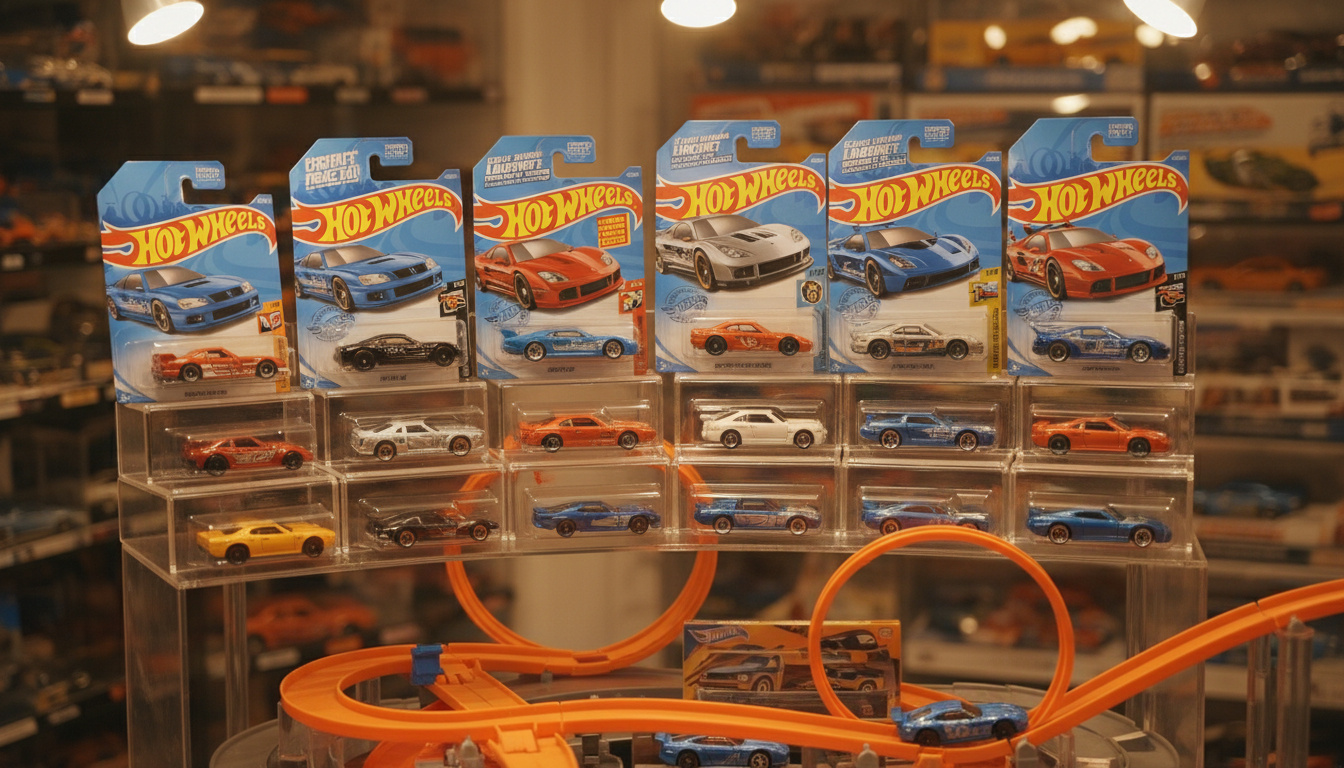
Hot Wheels cars have dominated the die-cast toy market since their debut in 1968, establishing Mattel as a powerhouse in miniature automotive culture. These 1:64 scale vehicles revolutionized play by combining speed-focused engineering with bold hot rod aesthetics, distinguishing themselves from static collectibles through compatibility with orange plastic tracks designed for high-speed racing.
Originally conceived by Mattel co-founder Elliot Handler as a masculine counterpart to Barbie, the brand emerged from Handler’s observation of his son playing with Matchbox cars. The inaugural line featured 16 customized “hot rod” designs emphasizing velocity over realism, a philosophy that propelled the brand to produce over six billion units by 2018 and transform into a media franchise spanning licensed replicas, collector editions, and competitive racing circuits.
What Are Hot Wheels Cars?
1968 by Mattel
1:64 die-cast
Spectraflame paint, Redline tires
40+ new castings per year
Key characteristics defining the brand:
- Die-cast zinc alloy construction optimized for track performance through low-friction axle design
- Originated as direct competition to Matchbox, prioritizing speed and stunt capability over static display
- Distinctive Spectraflame paint application and red-line tire sidewalls on 1968-1977 “Redline” series
- “HW” base markings indicating authentic Mattel manufacturing
- Compatibility with modular orange plastic track systems since inception
- Over six billion units manufactured by 2018 according to production data
- Treasure Hunt limited editions introduced post-1990s targeting adult collectors
| Attribute | Specification |
|---|---|
| Manufacturer | Mattel, Inc. (founded 1945) |
| Launch Date | May 18, 1968 |
| First Production Model | Custom Camaro (dark blue) |
| Original Collection | Sweet 16 (16 castings) |
| Rarest Known Variant | Rear-Loader Beach Bomb (prototype) |
| Key Engineering Innovation | Low-friction axle design for track racing |
| Primary Market Distinction | Speed-optimized vs. static display models |
| Acquisition Milestone | Matchbox parent company Tyco acquired 1997 |
History of Hot Wheels Cars
Origins and Invention
Mattel, established in 1945 by Harold “Matt” Matson, Ruth, and Elliot Handler, developed Hot Wheels after Handler observed his son playing with Matchbox vehicles and identified a market gap for a boys’ equivalent to the company’s Barbie line. Handler commissioned designers Harry Bentley Bradley and Jack Ryan to create a line emphasizing speed and exaggerated hot rod styling rather than the realistic replicas Matchbox offered.
The development team engineered low-friction axles and Spectraflame paint finishes for the inaugural “Sweet 16” collection. Bradley contributed 11 of the 16 original designs, including the Beatnik Bandit, Custom Fleetside, Deora, Twin Mill, Splittin’ Image, Torero, and Turbofire. Early prototypes such as the Rear-Loader Beach Bomb failed track testing due to center-of-gravity instability, leading to design modifications before commercial release.
Unlike competitors focusing on static authenticity, the design team prioritized track performance. Jack Ryan’s engineering contributions and Bradley’s automotive styling created vehicles specifically calibrated for the orange plastic stunt tracks, establishing the brand’s fundamental identity as a racing toy rather than a display model.
Key Milestones by Decade
The 1968 New York Toy Fair launch disrupted the miniature car market, with television advertisements claiming the “fastest cars in the world” driving immediate commercial dominance. The initial release prompted Matchbox to accelerate innovation to maintain market share.
The 1969 expansion introduced the Show & Go series, featuring Twin Mill and Splittin’ Image as the first in-house original designs rather than licensed replicas. By 1970, the brand had established dedicated collectors’ clubs and introduced the Snake and Mongoose drag racer models, legitimizing adult collecting through official certificates and documentation kits.
The 1981 introduction of “The Hot Ones” wheel series improved speed performance, coinciding with a production shift to Malaysia by 1983. The late 1980s brought “Blue Card” packaging establishing the modern blister pack standard, while 1993 saw the debut of “Revealers” and Mystery Car concepts. The 1997 acquisition of Tyco Toys (Matchbox’s parent company) consolidated Mattel’s dominance in the die-cast sector.
Most Valuable Hot Wheels Cars
Top Rare Models
The earliest Redline series (1968-1977) commands the highest premiums in secondary markets. The original Sweet 16 castings featuring Custom Camaro, Deora, and Twin Mill achieve significant value when preserving original Spectraflame paint and uncracked red-line tires. The Rear-Loader Beach Bomb prototype represents the ultimate scarcity, with so few examples surviving track-test failures that authenticated specimens rank among the most expensive die-cast vehicles transacted.
Transitional rarities include the 1970 Snake and Mongoose drag racing pairs and 1981 Hot Ones series such as Science Friction, representing the final U.S. production era before the Malaysian manufacturing shift. Post-1997 licensed models and Treasure Hunt editions with special markings demonstrate appreciation potential, particularly those maintaining factory-sealed condition.
Factors Affecting Value
Condition serves as the primary value determinant, with “mint” specimens retaining original paint without touch-ups, unswapped wheels, and intact blister packaging commanding substantial premiums. Originality verification requires examination of base markings and paint consistency, as reproduction Spectraflame colors and counterfeit Redline tires circulate within collector markets. Production origin also influences pricing, with U.S.-manufactured examples from 1968-1982 generally outperforming subsequent Malaysian production in rarity metrics.
Are Hot Wheels Cars Collectible?
Collecting Strategies
Serious collectors prioritize the Sweet 16 and early Redline series for long-term value retention, though entry-level enthusiasts often begin with accessible Treasure Hunt releases or themed series aligned with automotive interests. Authentication requires familiarity with Mattel’s manufacturing evolution, including base stamp variations and paint application techniques specific to production eras.
Authentic Redline models manufactured between 1968 and 1977 feature distinct red stripes on tire sidewalls visible without magnification. However, the presence of Spectraflame paint alone does not guarantee authenticity, as reproduction finishes and replacement wheels have become sophisticated. Provenance documentation from the 1970s collectors’ clubs provides the strongest authentication for high-value transactions.
Play Versus Investment Editions
Mainline production cars available at retail typically range $1-5, designed for track durability and child play. Limited editions targeting adult collectors, including Treasure Hunts with special “Hunt” symbols and premium finish series, occupy higher price tiers and require protection from dust and ultraviolet exposure to maintain condition. The collecting community distinguishes between “track cars” for active racing and “shelf queens” maintained in pristine packaging for value appreciation.
Current market valuations for rare Hot Wheels fluctuate significantly based on auction timing and ephemeral collector demand. While 1968-1969 originals consistently demonstrate premium pricing, comprehensive price guides for post-2020 releases remain unavailable, requiring direct comparison of recent auction results rather than standardized catalog values for accurate assessment.
Hot Wheels Cars List by Year
-
: Mattel founded in California by Harold “Matt” Matson, Ruth, and Elliot Handler.
— 164custom.com -
: Sweet 16 manufacturing commences; first Custom Camaro produced.
— Hot Wheels Fandom -
: Official market launch May 18; 16 castings debut at New York Toy Fair; orange track system introduced.
— Motor Cities -
: Show & Go series released featuring first in-house designs Twin Mill and Splittin’ Image.
— Wikipedia -
: Snake and Mongoose drag racers introduced; first official collectors’ clubs established with certification kits.
— Motor Cities -
: The Hot Ones wheel series debuts; production begins transition to Malaysia (completed 1983).
— 164custom.com -
: Distribution expansion includes Kellogg’s cereal box premiums; shift toward 1980s economy car models like Pontiac Fiero.
— Hot Wheels Fandom -
: Revealers series launches; first Mystery Car concepts introduced.
— 164custom.com -
: Mattel acquires Tyco Toys (Matchbox parent company); Kyle Petty campaigns first Hot Wheels branded stock car in NASCAR.
— Highsnobiety
What Is Known vs. Uncertain About Hot Wheels Values
| Established Information | Information Requiring Verification |
|---|---|
| Mattel has manufactured Hot Wheels continuously since May 18, 1968 | Exact current market values for releases post-2020 remain undocumented in comprehensive guides |
| Redline series production definitively occurred 1968-1977 | Precise year Treasure Hunts began remains unspecified (sometime post-1990s) |
| Sweet 16 constitutes the original 1968 collection | Specific production quantities for limited editions are not publicly disclosed |
| Rear-Loader Beach Bomb prototypes failed track testing due to instability | Authentication of modified or restored Redline models requires physical expert examination |
| Mattel acquired Tyco (Matchbox owner) in 1997 | Future appreciation rates for contemporary series cannot be projected from available data |
Cultural Impact and Market Position
Hot Wheels transformed the toy automotive sector by proving that miniature vehicles could function as dynamic racing equipment rather than static shelf displays. The brand’s emphasis on speed engineering—low-friction axles, lightweight die-cast bodies, and track-optimized wheelbases—established a product category distinct from the realistic replicas that dominated the 1960s. This innovation compelled competitors to develop their own track-compatible systems, fundamentally altering how children interacted with toy cars. For those interested in premium outdoor lifestyle products that emphasize design excellence similar to classic automotive collectibles, consider the Weeping Lilly Pilly – Care Pruning and Growing Guide for enhancing your display environment.
The evolution from children’s plaything to adult investment vehicle reflects broader trends in nostalgia-driven collecting. By 2018, production exceeded six billion units, demonstrating mass-market penetration rare among specialty collectibles. The brand’s acquisition of Matchbox’s parent company in 1997 consolidated Mattel’s control over the die-cast narrative, though Hot Wheels maintained its distinct identity emphasizing fantasy hot rods over realistic licensing. Modern releases balance accessibility for juvenile racers with limited editions catering to the demographic that purchased original Sweet 16 models during childhood.
Documentation and Expert Sources
The 1968 launch at the New York Toy Fair disrupted the market immediately, with television advertising claiming the ‘fastest cars in the world’ and establishing the orange track as a household staple.
— AAA Magazine
Bradley contributed 11 of the 16 original designs, establishing the brand’s signature aesthetic of exaggerated hot rod features specifically engineered to outperform competitors on plastic tracks.
— Motor Trend
By 2018, over six billion units had been produced, cementing the brand’s status as both a play object and a cultural touchstone spanning multiple generations.
— The Strong National Museum of Play
Key Takeaways for Enthusiasts
Hot Wheels cars occupy a unique position bridging mass-market toys and serious collectibles, with value determinants ranging from childhood play patterns to auction-grade investment strategies. Collectors seeking long-term appreciation should prioritize 1968-1977 Redline models in original condition, while enthusiasts entering the market might explore Treasure Hunts or themed series aligned with personal automotive interests. Proper storage away from ultraviolet light and humidity preserves Spectraflame finishes and tire integrity across both play and investment portfolios. When curating display spaces for your collection, the Outdoor Coffee Table – Best Materials Sizes and Picks provides durable surface options suitable for showcasing premium pieces.
Frequently Asked Questions
How much are rare Hot Wheels worth?
Values vary dramatically by condition and rarity. Original 1968 Sweet 16 models with intact Spectraflame paint command significant premiums, while the Rear-Loader Beach Bomb prototype ranks among the most valuable due to extreme scarcity. Standard retail ranges $1-5, whereas mint Redlines reach four figures and prototypes exceed that threshold substantially.
What are the best Hot Wheels tracks?
The original orange plastic track system remains compatible with modern cars, featuring adjustable configurations for stunts and gravity racing. Contemporary sets include motorized boosters and digital timing systems. Selection depends on intended use—basic loops for durability, crash sets for dramatic play, or modular systems for collection integration.
Where can you buy Hot Wheels cars?
Current production runs are available at major retailers and toy stores. Secondary markets facilitate acquisition of vintage Redlines and rare prototypes, while collector clubs established since 1970 provide networks for authenticated private sales. Malaysian-era production (post-1983) offers affordability for beginning collectors.
How do you identify authentic Redline Hot Wheels?
Authentic Redline models (1968-1977) feature visible red stripes on tire sidewalls, Spectraflame paint visible through chrome edges, and “HW” base markings. U.S.A. or Hong Kong manufacturing stamps indicate production era. Expert verification is recommended as reproduction wheels and repainted bodies circulate within markets.
What distinguishes Hot Wheels from Matchbox?
Hot Wheels emphasize exaggerated hot rod styling, speed-optimized axles, and track compatibility. Matchbox traditionally focused on realistic production vehicle replicas. Mattel acquired Matchbox’s parent company in 1997, though the brands maintain distinct design philosophies and target demographics.
Are Treasure Hunts worth collecting?
Treasure Hunts represent limited editions with special markings introduced for adult collectors. While specific start years remain unclear, these models typically appreciate above retail value when maintained in pristine condition. They serve as an accessible entry point between standard mainline cars and high-value vintage Redlines.
Related stories


Liam O'Brien covers Australian politics and public affairs for Coast Monitor.